
How Does a Mortgage Investment Corporation Evaluate a Mortgage?
Why Loan-to-Value Is Only Part of the Decision
OSM Mortgage Investment Corporation
In this article

A loan-to-value ratio can make a mortgage look reassuringly simple. If a property is valued at $1 million and the mortgage debt being measured is $650,000, the calculation produces a 65% LTV. The number is useful because it tells us how much debt is being measured against the value attributed to the property.
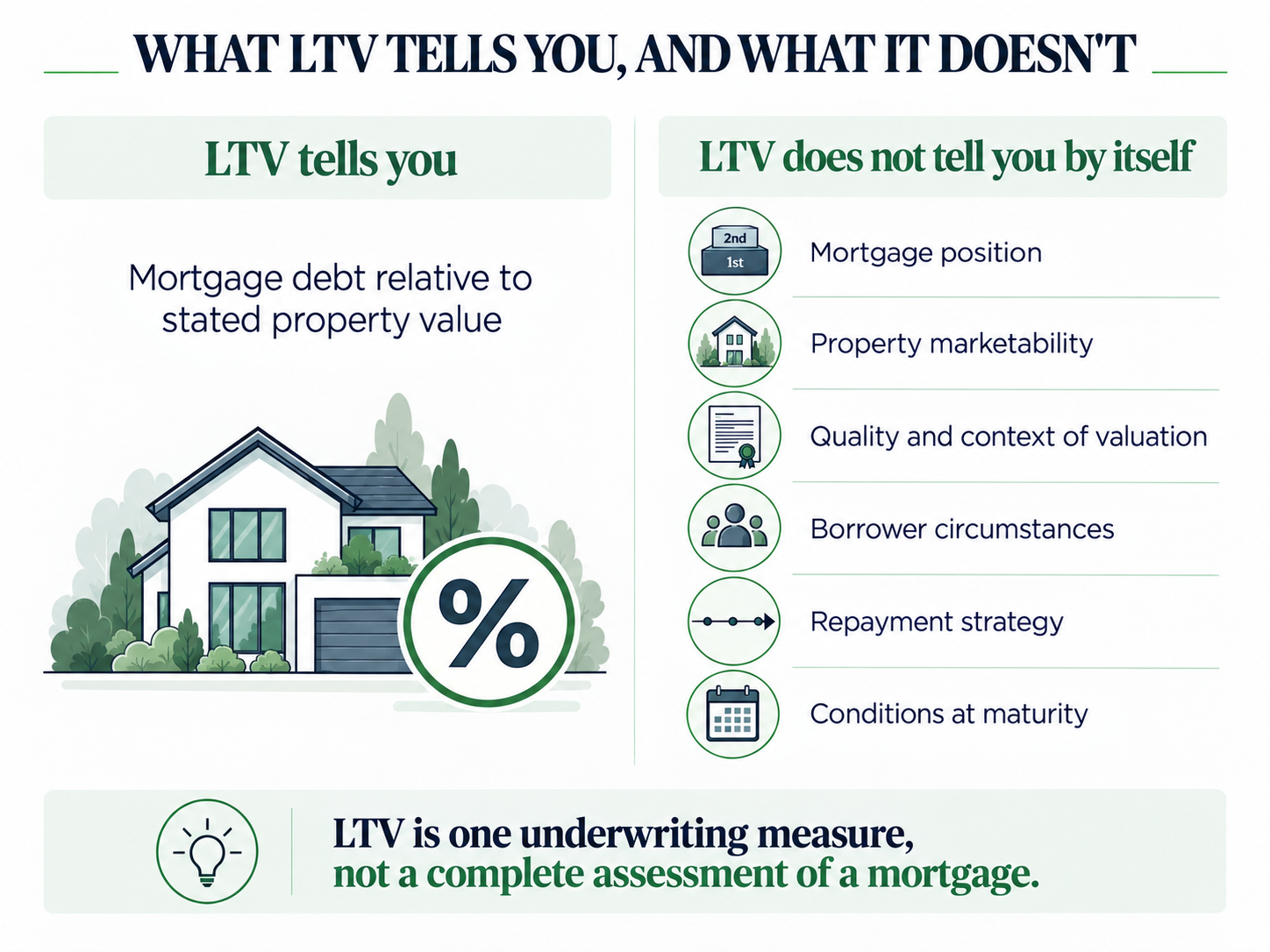
The difficulty is that the ratio stops there. It does not tell us what kind of property sits behind the appraisal, how readily that property could be sold, whether another mortgage ranks ahead of the proposed loan, how the borrower expects to repay the debt, or whether those assumptions will still hold when the mortgage reaches maturity.
For a Mortgage Investment Corporation, or MIC, that distinction matters because a portfolio may eventually be summarized through averages and percentages, but it is built one mortgage at a time. Every approval reflects a judgement about a particular borrower, property and repayment plan, which means two mortgages can show exactly the same LTV and still tell very different stories.
The Same LTV Can Describe Very Different Mortgages
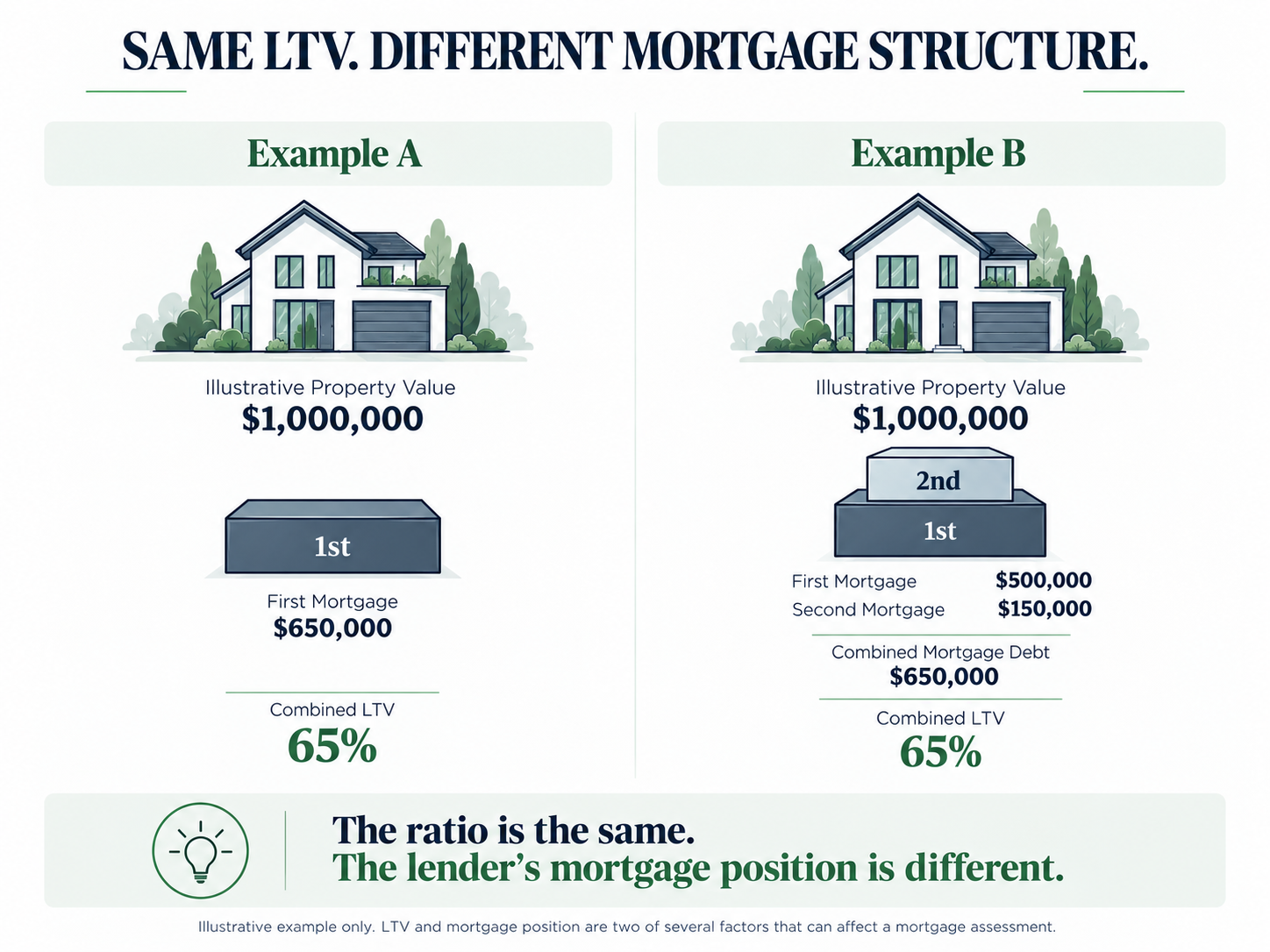
Imagine two properties, each valued at $1 million, with $650,000 of combined mortgage debt. Both show a 65% combined LTV, yet the resemblance can disappear quickly once an underwriter looks beneath the calculation.
One loan might be a $650,000 first mortgage on a conventional residential property in an established market. Another could involve a $500,000 first mortgage already registered against the property and a proposed $150,000 second mortgage. The property value and combined mortgage debt are the same in both examples, but the proposed lender occupies a very different position.
Mortgage priority matters because it affects the order in which mortgage claims would generally be addressed if the lender ultimately had to rely on the security, although other applicable legal priorities and claims can also affect recovery. A second mortgage is not automatically a poor lending decision, just as first position does not make a mortgage automatically low risk. The position changes the circumstances the lender needs to understand.
The same principle extends beyond priority. Properties differ in marketability, valuations are prepared under different conditions, and borrowers may have very different plans for repaying their debt. Experienced underwriting therefore treats LTV as one part of the file rather than a verdict on the mortgage. The more useful question is what that LTV means for this mortgage, in this position, against this particular property, and that brings the analysis back to the value assigned to the property in the first place.
The Valuation Gives the Ratio Meaning
Every LTV calculation depends on a property value, so the quality and context of that valuation matter. If the value changes, the meaning of the ratio changes with it, which is why an appraisal should be read as evidence rather than as a guaranteed future outcome.
An appraisal provides an informed estimate at a particular point in time. It can be an important part of the underwriting file, but it cannot determine what the property will sell for later, how long a sale might take or what costs could arise if the lender eventually has to rely on its security. BC Securities Commission investor guidance likewise identifies property valuation and LTV as distinct areas MIC investors should understand rather than treating either number as conclusive on its own.
Properties are not equally marketable. A conventional home in an active residential neighbourhood may have a broad pool of potential purchasers and a substantial body of comparable sales, while a more specialized property may appeal to fewer buyers or be harder to compare with recent transactions. Its appraisal may still be well supported, but the practical characteristics of the security are different.
Location, condition and property type help the lender interpret the final appraised value. A $1 million appraisal against $650,000 of mortgage debt leaves a $350,000 difference on paper, but that difference is not cash sitting in reserve. The amount ultimately realizable from the property can be affected by market movement, selling costs, legal costs and the circumstances that exist at the time. Even a well-supported valuation therefore leaves another question unanswered: how is the mortgage actually expected to be repaid?
The Property and the Repayment Plan Both Matter
Real estate may provide security for a mortgage, but a lender would generally rather see the loan repaid as planned than have to rely on the property through enforcement. That makes the expected source of repayment, sometimes described as the borrower's exit strategy, an important part of the lending decision rather than an afterthought.
The expected path can take different forms. A borrower may plan to refinance once a temporary issue has been resolved, sell the property, complete another transaction or move into longer-term financing once circumstances change. What matters is not simply whether an exit strategy can be described, but whether the proposed path makes sense in the context of the borrower, the property and the term of the mortgage.
Timing is part of that judgement. A plan that appears reasonable over eighteen months may become less convincing if it depends on several uncertain events occurring in a narrow sequence, so an underwriter may need to understand what has to happen, what could delay it and what alternatives exist if the original plan does not unfold as expected.
This is another reason private mortgage lending cannot be reduced to property value or LTV. A property may provide meaningful security while the repayment plan still raises questions, and a borrower may have a credible path to repayment while other aspects of the property or mortgage structure deserve closer examination. The lending decision comes from considering those elements together, and the real test of those assumptions begins after the mortgage is funded.
The Mortgage Still Has to Be Managed After Funding
A mortgage does not stop requiring attention once the funds have been advanced. Payments have to be received and recorded, maturity dates tracked, documentation maintained and changing circumstances understood when they become relevant. The original underwriting decision may have been made at the beginning of the loan, but many of the assumptions behind that decision continue to be tested throughout the mortgage term.
Some developments are routine, while others can alter the picture materially. A borrower may encounter financial difficulty, a contemplated sale or refinancing may be delayed, market conditions may weaken, or circumstances affecting the property may change. A missed payment is an obvious signal, but it is not the only reason a lender may need to revisit what was expected when the mortgage was approved.
Ongoing mortgage administration gives the lender an opportunity to understand those changes before maturity arrives. Maturity is particularly revealing because it is where the repayment strategy contemplated at the beginning of the mortgage meets the circumstances that actually developed during the term. If refinancing was expected, the lender can see whether it is now available; if repayment depended on a property sale, the question becomes whether that sale occurred or remains realistic.
The decision at maturity should reflect the mortgage as it exists at that point rather than simply repeat the assumptions made at origination. Repayment may occur as planned, but a renewal, extension, alternative financing source or another response may need to be considered depending on the facts. For a MIC, this matters because the portfolio is shaped not only by which mortgages enter it, but also by how those mortgages are administered as borrowers, properties and market conditions change.
What the Underwriting Process Tells Us About a MIC Portfolio
A MIC portfolio is easy to summarize with statistics. Average LTV, mortgage count, geographic distribution and the mix of mortgage positions can all provide useful information, but they describe the result more readily than they explain the decisions behind it.
Every mortgage in the portfolio began with someone examining a property, valuation, borrower, mortgage position and expected path to repayment. The portfolio is therefore the cumulative result of many lending judgements made over time, which helps explain why two MICs can report similar averages while holding mortgages with materially different characteristics.
Diversification deserves the same care. A portfolio containing many mortgages may spread exposure across more loans, but mortgage count alone does not reveal whether those loans are concentrated in one market, property type, borrower group or maturity period. Portfolio statistics become more useful when the reader understands what sits underneath them and how the loans differ from one another.
For someone considering a MIC, underwriting becomes relevant without becoming a promise about future results. A structured process cannot eliminate borrower, property or market risk, but it can show how the lender approaches uncertainty before committing capital and how individual lending decisions contribute to the portfolio shareholders ultimately have exposure to. The numbers describe the portfolio; the underwriting process helps explain how it was built.
How OSM MIC Approaches Mortgage Review
The principles discussed throughout this article become more meaningful when they can be connected to an actual lending process. We review mortgage opportunities individually rather than assessing them solely through conventional measures such as standard debt-service ratios or a credit score. The broader financial circumstances of the borrower also form part of our review.
Our current Lending Guide uses loan-to-value criteria and identifies first- and second-position mortgages among our lending options. Those parameters provide useful structure, but they sit inside a broader consideration of the proposed mortgage rather than replacing judgement about the file.
We also maintain communication as mortgages approach maturity, including reaching out before the maturity date to discuss the client's plans and the options available. That connects the original lending decision with the ongoing administration of the loan because borrower plans, property circumstances and refinancing options can change over the mortgage term.
These practices do not guarantee the performance of an individual mortgage or an investment in OSM MIC. Their relevance is that the portfolio is built and administered through individual lending decisions rather than through a single formula. For a prospective investor, that provides useful context for the portfolio information presented elsewhere and connects our mortgage experience to the work involved in managing mortgage assets.
What an Investor Can Learn From the Process
Understanding mortgage underwriting cannot tell someone how a MIC will perform in the future, but it can make the portfolio easier to understand. An average LTV becomes more meaningful when the reader knows something about the properties, mortgage positions and valuations behind it, and management experience becomes more informative when it can be connected to actual lending responsibilities.
The same applies to other portfolio statistics. Mortgage count tells us more when we understand how the loans differ by geography, property type, borrower and maturity, while a description of the management team becomes more useful when it shows how those people think about property value, repayment strategy, mortgage position and maturity rather than simply stating how many years they have worked in the industry.
None of this removes the risks associated with MIC investing. Borrowers can encounter difficulty, property values can change, valuations can prove optimistic and circumstances can evolve after a mortgage is funded. BC Securities Commission investor guidance likewise encourages investors to look at portfolio composition, valuation, LTV, fees and liquidity rather than relying on a headline return or the fact that mortgages are secured by real estate.
What the underwriting process offers is context. It helps explain how mortgages entered the portfolio, what assumptions supported those decisions and how the loans may be managed as circumstances change. For OSM MIC, that is the connection between its mortgage-lending operation and the portfolio a prospective investor is ultimately trying to understand.
Review Current OSM MIC Offering Information
This article is provided for general educational information and does not reproduce the current terms of the OSM MIC offering. Current investment-specific information, offering documents and applicable disclosures are available through SMV Capital Markets.
FrontFundr Financial Services Inc., doing business as FrontFundr and SMV Capital Markets, is registered as an exempt market dealer. SMV states that it provides advice regarding the suitability of investment opportunities available through its platform.
Investing in exempt market offerings involves significant risk, including the possibility of losing some or all of an investment and limitations on resale. Prospective investors should review the applicable offering information and disclosures before making an investment decision.
Visual sourcing note: Figures 1–3 are original OSM MIC educational graphics created for this article. Illustrative examples are not OSM MIC portfolio data. The mortgage, valuation and investor-education concepts used in the graphics are supported by the live sources listed below.
Sources and Further Information
Live links verified September 14, 2026.
• BC Securities Commission, InvestRight — What Are Mortgage Investment Corporations?
• Government of Canada — Income Tax Act, section 130.1: Mortgage Investment Corporations
• OSM Mortgage Investment Corporation — Brokers and Lending Guide
• SMV Capital Markets — OSM Mortgage Investment Corporation Campaign
